Saltar al contenido
232.514 perfiles en la clasificación

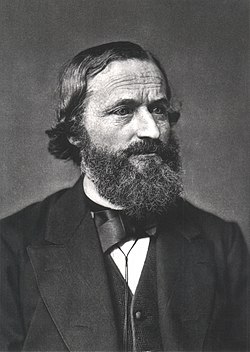
Gustav Kirchhoff

Científicos · Vivió de 1824 a 1887 · 63 años

Gustav Robert Kirchhoff (Königsberg, nacido 12 de marzo de 1824-Berlín, fallecido 17 de octubre de 1887) fue un físico prusiano, cuyas principales contribuciones científicas se centraron en los campos de los circuitos eléctricos, la teoría de placas, la óptica, la espectroscopia y la emisión de radiación del cuerpo negro.

Texto de Wikipedia, CC BY-SA 4.0

Gustav Kirchhoff: unas 370 lecturas al día, en 85 idiomas.

Un día típico de los 30 días hasta el 20 de noviembre de 2026

El valor central de los días contados, para que una semana de noticias no pueda alterarlo. La línea de abajo muestra los últimos 400 días, un punto por día.

¿Hay algún error?
Comparar

Una vida en fechas

1887Fallecimiento17 de octubre de 18871882“All heat rays follow the same laws in their propagation, which are known for light rays.”En sus palabrasof Bodies for Heat and Light. As quoted in The Laws of Radiation and Absorption: Memoirs by Prévost, Stewart, Kirchhoff, and Kirchhoff and

“Of the heat rays... sent... to a body by its surroundings a part are absorbed, the others are... varied by reflection and . The rays refracted and reflected... pass off...”En sus palabrasof Bodies for Heat and Light. As quoted in The Laws of Radiation and Absorption: Memoirs by Prévost, Stewart, Kirchhoff, and Kirchhoff and

“In certain cases an exception to this rule may occur... [when] absorption and the radiation produce other changes in the body.., for example in bodies...”En sus palabrasof Bodies for Heat and Light. As quoted in The Laws of Radiation and Absorption: Memoirs by Prévost, Stewart, Kirchhoff, and Kirchhoff and

“Such cases should be excluded on the assumption that neither by means of the rays which it radiates or absorbs, nor by... other influences... does the body...”En sus palabrasof Bodies for Heat and Light. As quoted in The Laws of Radiation and Absorption: Memoirs by Prévost, Stewart, Kirchhoff, and Kirchhoff and

“A ... must have the same as the medium... then there will be no reflection at its surface, and all incident rays... wholly absorbed.”En sus palabrasof Bodies for Heat and Light. As quoted in The Laws of Radiation and Absorption: Memoirs by Prévost, Stewart, Kirchhoff, and Kirchhoff and

1877Medalla DavyPremioMedalla MatteucciPremioOrden bávara de Maximiliano para la Ciencia y las ArtesPremio1875Miembro extranjero de la Royal SocietyPremio1868Honorary Fellow of the Royal Society of EdinburghPremio1862Medalla RumfordPremio1824“Let a body which satisfies these conditions be surrounded by an enclosure, having the same temperature [and kept constant], through which no heat rays can penetrate...”En sus palabrasNotes: Carnot's Reflections on the Motive Power of Heat (1824): The production of motion in steam-engines is always accompanied by... the

Nacimiento12 de marzo de 1824

En torno a Gustav

Multimedia y música

Fotos 8

En sus propias palabras 4

,
Gustav Kirchhoff
,
4 declaraciones, las más recientes primero
  1. Heat rays have the same nature as light rays... The invisible heat rays are distinguished from light rays only by the period of or the wave length.

    1882 · of Bodies for Heat and Light. As quoted in The Laws of Radiation and Absorption: Memoirs by Prévost, Stewart, Kirchhoff, and Kirchhoff and, En sus palabras

  2. Through the radiations... a body sends out, the quantity of ... it contains will... sustain a loss... equivalent to the of those rays, and through the heat rays...

    1882 · of Bodies for Heat and Light. As quoted in The Laws of Radiation and Absorption: Memoirs by Prévost, Stewart, Kirchhoff, and Kirchhoff and, En sus palabras

  3. This investigation will be... simplified if we imagine the enclosure... composed...

    1882 · of Bodies for Heat and Light. As quoted in The Laws of Radiation and Absorption: Memoirs by Prévost, Stewart, Kirchhoff, and Kirchhoff and, En sus palabras

Wikiquote, CC BY-SA 4.0

Premios

Medalla Matteucci1877
Orden bávara de Maximiliano para la Ciencia y las Artes1877
Medalla Davy1877
Miembro extranjero de la Royal Society1875
Honorary Fellow of the Royal Society of Edinburgh1868
Medalla Rumford1862
Orden del Mérito de las Ciencias y las Artes

Acerca de esta persona

Inventó el espectroscopio y junto con Robert Bunsen descubrió el rubidio y el cesio por métodos espectrales. Identificó la raya D del espectro solar como la producida por sodio vaporizado. Descubrió las leyes generales que rigen el comportamiento de un circuito eléctrico. Se dedicó al estudio de la termodinámica y realizó investigaciones sobre la conducción del calor. Estudió los espectros del Sol, de las estrellas y de las nebulosas, confeccionando un atlas del espacio y demostró la relación existente entre la emisión y la absorción de la luz por los cuerpos incandescentes. Kirchhoff propuso el nombre de radiación de cuerpo negro en 1862. Es responsable de dos conjuntos de leyes fundamentales, en la teoría clásica de circuitos eléctricos y en la emisión térmica. Aunque ambas se denominan Leyes de Kirchhoff, probablemente esta denominación es más común en el caso de las Leyes de Kirchhoff de la ingeniería eléctrica.

Texto de Wikipedia, CC BY-SA 4.0

Categoría
Científicos
Tipo
Ciencia
Estado
Persona fallecida
Fechas
Vivió de 1824 a 1887 · 63 años