Saltar al contenido
231.985 perfiles en la clasificación

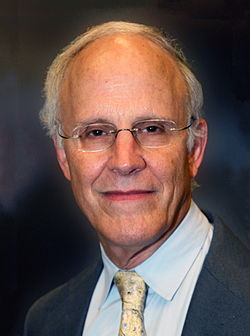
David Gross

Estados Unidos · En el mapa · Científicos · Nació en 1941 · 85 años

David Jonathan Gross (19 de febrero de 1941) es un físico, profesor estadounidense y teórico de cuerdas. Junto con Frank Wilczek y David Politzer recibió el Premio Nobel de Física en 2004 por el descubrimiento de la libertad asintótica.

Texto de Wikipedia, CC BY-SA 4.0

David Gross: unas 330 lecturas al día, en 73 idiomas.

Un día típico de los 30 días hasta el 20 de noviembre de 2026

El valor central de los días contados, para que una semana de noticias no pueda alterarlo. La línea de abajo muestra los últimos 400 días, un punto por día.

¿Hay algún error?
Comparar Reclamar

Una vida en fechas

2015“Physics is always a gamble; it is a game of exploration. That’s the fun of it. We never know for sure what will happen.”En sus palabras"Physics is always a gamble", an interview with David Gross by Shubashree Desikan, The Hindu (2015)

2013“Remarkably, the building of the Standard Model - the theory of how particles and forces interact - was the success of the conservatives.”En sus palabras"Waiting for the Revolution", an interview of David Gross by Peter Byrne, Quanta Magazine (2013)

2004“... From the age of 13, I was attracted to physics and mathematics. My interest in these subjects derived mostly from popular science books that I read avidly.”En sus palabras"David J. Gross - Biographical", Nobel Prize in Physics, nobelprize.org (2004)

“The universe has been expanding since the big bang, thus early on it was hot and dense.”En sus palabras"The Discovery of Asymptotic Freedom and the Emergence of QCD", Nobel Lecture, p. 79, nobelprize.org (2004)

1987Beca MacArthurPremio1941Nacimiento19 de febrero de 1941

En torno a David

Multimedia y música

Fotos 1

En sus propias palabras 3

,
David Gross
,
3 declaraciones, las más recientes primero
  1. Traditionally, fundamental theories of nature have had a tendency to break down at short distances.

    "Chapter 7. Asymptotic Freedom, Confinement and QCD" in History of original ideas and basic discoveries in particle physics, edited by, En sus palabras

  2. Why is space-time doomed? There are many reasons, among which: In string theory we can change the dimension of space-time by changing the strength of the string force.

    "Einstein and the Search for Unification", p. 11, in The legacy of Albert Einstein: a collection of essays in celebration of the year of, En sus palabras

  3. We now know that string theory and quantum field theory can often be different ways of looking at exactly the same phenomena.

    (quote at 1:53:25 of 2:13:05 in video), En sus palabras

Wikiquote, CC BY-SA 4.0

Premios

Beca MacArthur1987
Miembro de la Sociedad Estadounidense de Física

Acerca de esta persona

País
Estados Unidos
Categoría
Científicos
Tipo
Ciencia
Estado
Con vida
Fechas
Nació en 1941 · 85 años

En internet