Carlo Sini
Italia · En el mapa · Académicos · Nació en 1933 · 92 años
Académico italiano, nacido en 1933.
Carlo Sini: unas 36 lecturas al día, en 4 idiomas.
Un día típico de los 30 días hasta el 21 de noviembre de 2026
El valor central de los días contados, para que una semana de noticias no pueda alterarlo. La línea de abajo muestra los últimos 400 días, un punto por día.
¿Hay algún error?Una vida en fechas
2018“When I say that truth is “relatively absolute,” I mean that the search for truth, which we cannot renounce, always takes place within a relationship.”En sus palabras29 de marzo de 2018Alessandro Zaccuri, Carlo Sini: «La verità? Sta sempre nella relazione», Avvenire 29 de marzo de 2018“Vico and Foscolo had already warned us: where there is a tomb, there is civilization, which presupposes a community between the living and the dead.”En sus palabras29 de marzo de 2018Alessandro Zaccuri, Carlo Sini: «La verità? Sta sempre nella relazione», Avvenire 29 de marzo de 20182013“Ultimately, the last word is never ours. Peirce said: the meaning of my life is entrusted to others.”En sus palabras14 de febrero de 2013Antonio Gnoli, la Repubblica“(About Greek philosophy and Christianity) In these philosophies or worldviews, there is an idea of perfection that has caused damage and misunderstanding.”En sus palabras14 de febrero de 2013Antonio Gnoli, la Repubblica2009“The path of speech (mythos odoio) (by Parmenides) contains within itself the path of day and that of night. It is no coincidence that Parmenides' poem comprises two parts.”En sus palabras17 de noviembre de 2009Giorgio Bubbolini, Intervista a Carlo Sini, Spiweb.it1995“(Referring to ideograms, ancient sophia, and Zen practice) The latter, for example, is an exercise that teaches us to inhabit the exercise itself.”En sus palabras24 de marzo de 1995Antonio Gnoli, la Repubblica1933Nacimiento6 de diciembre de 1933
En torno a Carlo
Vínculos cercanos


Multimedia y música
Fotos 1

En sus propias palabras 4
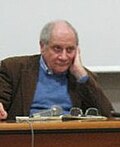 ,
Carlo Sini
, 4 declaraciones, las más recientes primero
The introduction of writing changes our perception of the world. The Logos, of which the Greeks speak, could not exist without writing. Interviewer: Why?
Unlike joy, which is a momentary experience, localized in specific times and reasons, happiness perhaps has a more general meaning.
The entire Western tradition originated there, in the sense that Socratic doubt is the passive non-acceptance of tradition. His question is why?
Acerca de esta persona
País
Italia
Categoría
Académicos
Tipo
Mundo académico
Estado
Con vida
Fechas
Nació en 1933 · 92 años